Embedded accounting

Embedded Accounting For Platforms

Paprel is the accounting layer underneath: a programmable double-entry ledger, signed webhooks, and MCP-native agent tools, embedded in your product under your brand. The same primitives run in production today.

paprel ▸ accounting · stack
live
System Mapv1.0
  • 01Product events and API orchestration
  • 02Double-entry ledger and sub-ledgers
  • 03Native accounting workflows
  • 04Reporting, permissions, and audit controls

minutes

to your first sandbox journal

weeks

to evaluate a scoped flow

7 yrs

signed audit retention

Spec sheet

What you wire up in the first two weeks

Four primitives every integration hits in its first sandbox. Each maps to a real endpoint, a signed event, and a row in the audit log.

POST /journals · idempotent

Post balanced double-entry journals over REST or SDK. Idempotency keys deduplicate retries; resubmitting the same request returns the original 201.

Webhooks v1 · signed

Every state change emits a signed webhook with a content hash, so downstream systems can verify exactly what happened.

OAuth 2.0 / 2.1 · scoped tokens

Standard OAuth 2.0 and 2.1 authorization flows with PKCE. Tenant-scoped tokens with per-route grants — same model powers RBAC, MCP, and machine-to-machine clients.

Sandbox tenant · 30-day window

Real OpenAPI client, real signed events, isolated data. Promote to production by swapping a token — same wire format, same primitives.

Category Definition

Defining embedded accounting

Embedded accounting is not just invoicing inside an app. It is a system of record built into a software product, where ledger logic, workflows, reporting, permissions, and audit history operate as native platform capabilities.

Best fit for

SaaS platforms turning workflow products into financial systems of record

Fintech products extending from money movement into accounting operations

Marketplaces and vertical software products with structured financial activity

Accounting-led platforms that need APIs, controls, and shared client workspaces

Not the primary fit

Freelancers looking for a lightweight standalone bookkeeping app

SMBs shopping for a generic accounting UI without platform requirements

Teams that only need invoicing or expense capture without a ledger-backed model

Products that do not need accounting controls, reporting integrity, or API extensibility

Where it fits

Four adjacent categories. Four different jobs.

The useful distinction is not the API shape. It is what the product owns and where the accounting system of record lives.

Accounting software

QuickBooks · Xero · NetSuite

What it does

A business logs in to keep its books.

Ownership boundary

Destination app

The customer leaves your product to keep the books.

Accounting API / aggregator

Codat · Rutter

What it does

Reads and syncs books held elsewhere.

Ownership boundary

Connector

The connected accounting platform remains the system of record.

Money-movement ledger

Modern Treasury · Fragment · Formance

What it does

Tracks balances and transaction flows.

Ownership boundary

Money ledger

It does not produce GAAP books or financial statements.

Embedded finance

Unit · Treasury Prime

What it does

Embeds banking, cards, and payments.

Ownership boundary

Financial services layer

It moves money; your accounting system still has to keep the books.

Paprel is the system of record: embedded double-entry books your platform owns.

Full comparisons
Build vs buy

Build the ledger, or build the product

A production-grade double-entry core takes a senior team 8–18 months and never ships finished. Below is what you delegate the moment you adopt Paprel.

See the full cost model
Own in-house
Delegate to Paprel

Complex debit/credit logic, edge case handling, and ledger integrity

Core Accounting Ledger

Production-ready double-entry foundations

Custom engineering for journals, adjustments, and audit controls

Regulatory Workflows

Prebuilt workflows designed for compliance

Manual effort to reconcile product activity with financial records

Financial Integrity

Programmatic synchronization with a shared source of truth

Technical debt accrual and continuous maintenance overhead

System Longevity

Scalable architecture that evolves with the industry

Keep your engineers on the product surface.

Compare options
Capability Map

The primitives, by name

Embedded accounting covers the ledger, workflows, reporting, permissions, and audit controls. The capability map shows the hosted surfaces, APIs, and rollout options around it.

01

Double-entry engine

POST a journal with balanced debits and credits. The engine rejects unbalanced postings, deduplicates by idempotency key, and writes to an append-only ledger. Multi-entity and multi-currency are built in, not modules.

02

Workflow primitives

Invoicing, expense, and reconciliation flows wired to the ledger. Drafts, approvals, and posting are first-class API states — not UI conventions.

03

API + webhooks + MCP

One OpenAPI spec generates clients in any language. OAuth 2.0 / 2.1 with PKCE for auth. Signed webhooks with content hashes. MCP surface lets AI agents post journals and read balances with scoped tokens.

Explore Capabilities
Industries

Built for three platform motions

The same primitives — programmable ledger, signed events, MCP surface — adapt to the shape of your business. A few of the patterns we see most.

Sector Profile

Fintech Platforms

Move beyond money movement and give business customers accounting tools that reflect what happens in their accounts, cards, lending, and treasury products.

Common use cases

01Business transaction ledgering
02In-app reporting and statements
03Cash movement tied to accounting entries
04Operational finance visibility

Why it matters

What ships

The product changes teams in this segment make once the accounting layer is wired in.

Deeper product utility
Stronger retention
Better financial visibility
New revenue opportunities
Explore Fintech Platforms

Early platform program

Start in sandbox, then shape the rollout

Paprel works closely with a small group of fintech, vertical SaaS, and marketplace teams adding accounting as a product capability. Start with a sandbox, validate your ledger model, then scope pricing around the rollout you actually need.

  • Direct line to the engineers building the ledger
  • Architecture review tailored to your platform
  • Early access to MCP tooling and pre-release platform capabilities
  • Pricing scoped to active books, volume, residency, and SLA needs

What partners get

48h
Architecture review turnaround
1:1
Direct founder channel
MCP
Early-access AI tool surface
UI
Co-design of partner-facing surfaces
System architecture

Three layers. One source of truth

Your application emits events. Paprel turns them into signed, validated, double-entry journals. Your read surfaces — reports, exports, audit trails — pull from the same ledger.

Same primitives running in production today.

Trace the full architecture

01 · Write

Product events

REST · webhooks · MCP

02 · Govern

Accounting engine

validate · compile · attribute

03 · Read

Financial truth

reports · exports · audit

MCP-Native · Live today

An accounting API that AI agents can call safely

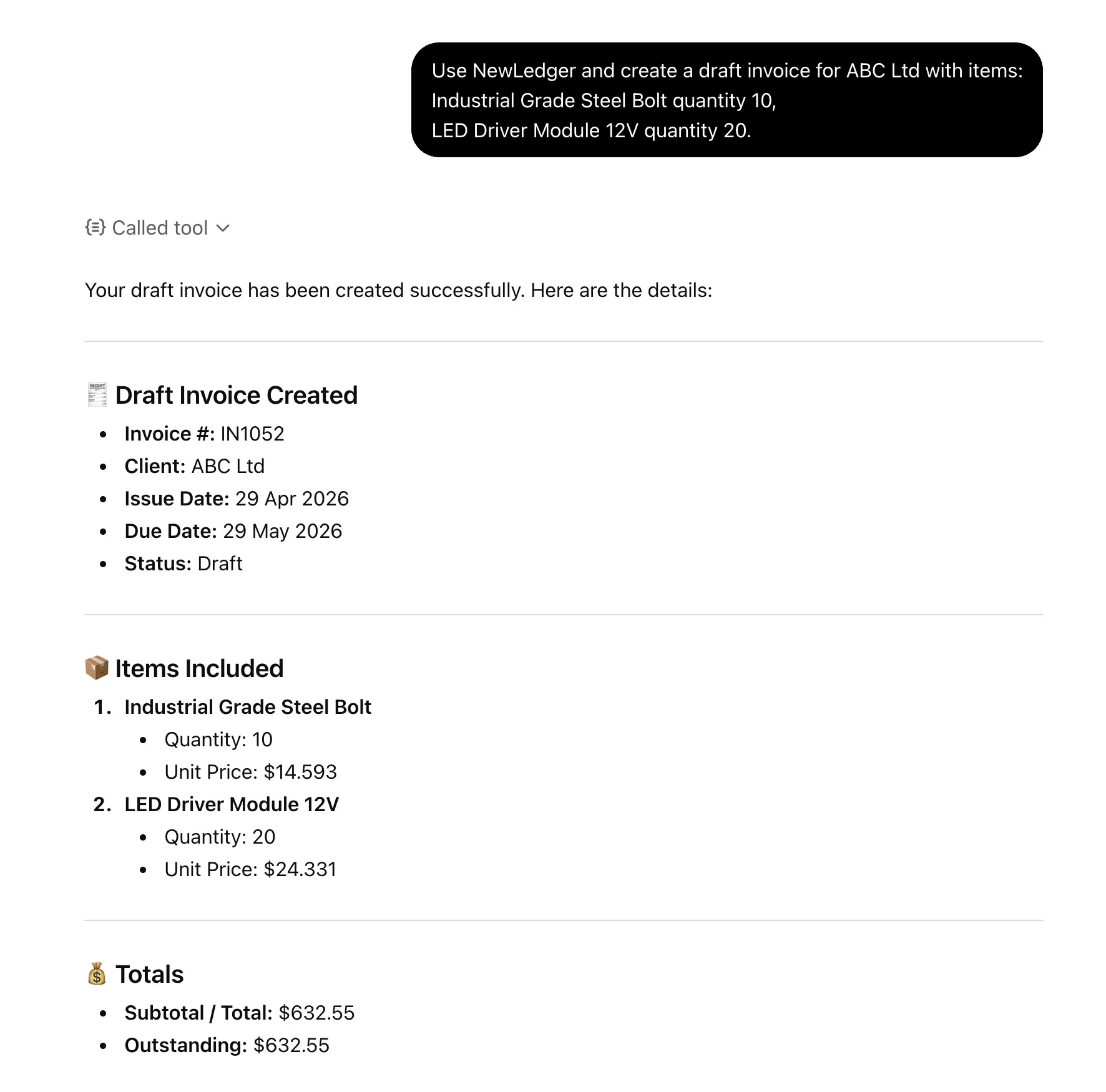
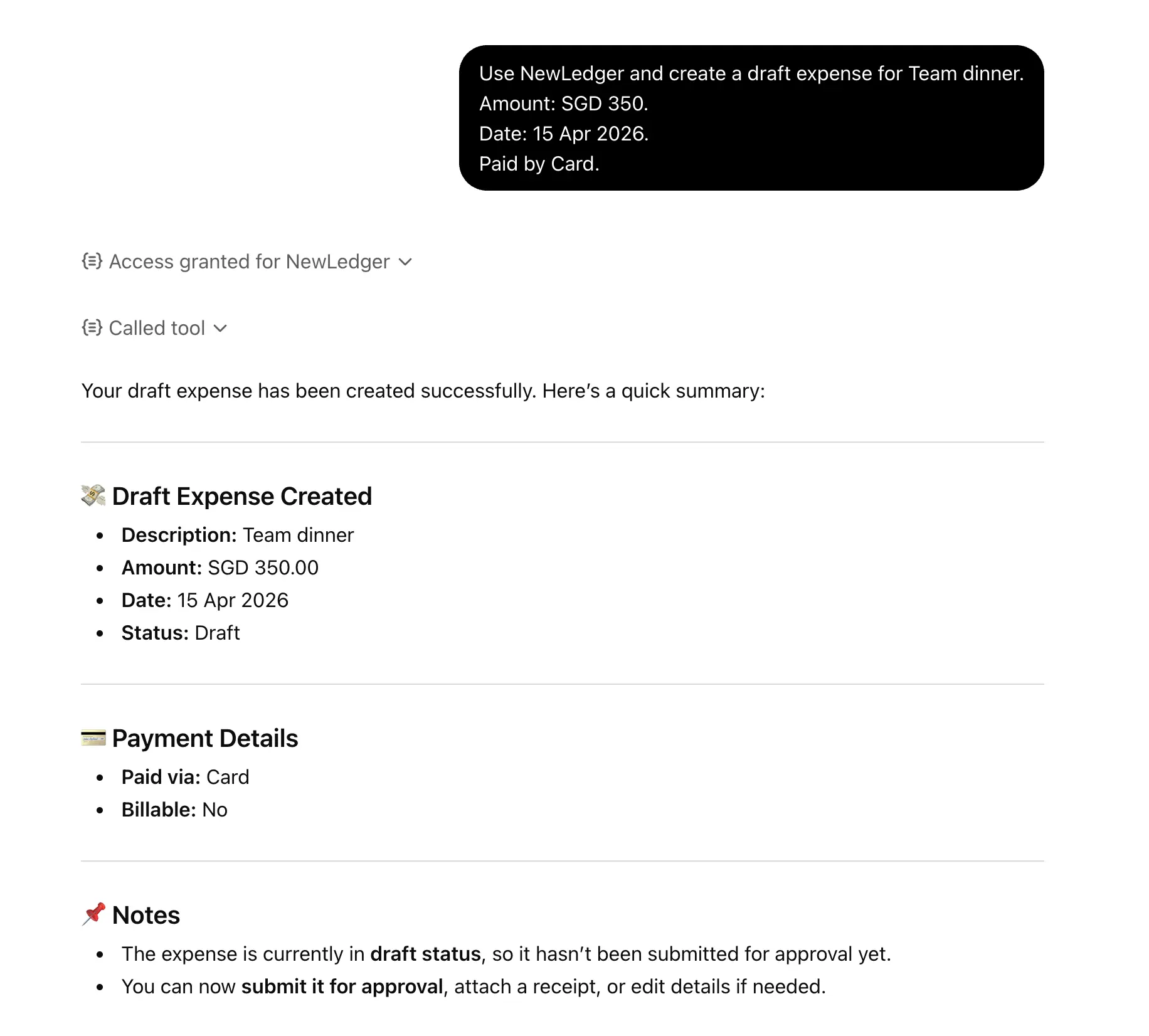
Paprel ships an MCP tool surface so AI agents can post journals, query balances, and propose corrections — through the same signed, audited, double-entry primitives your engineers use. No spreadsheet exports, no jailbroken admin seats.

  • Scoped tools — agents only see what their role can touch.
  • Draft actions — every agent edit lands as a pending journal, never auto-posted.
  • Full audit trail — who, what, when, signed.

Already shipping. These aren't mockups — the same MCP surface is live in production today. What you see below is real.

ChatGPT ▸ paprel
ChatGPT invoking paprel.invoices.create via Model Context ProtocolChatGPT invoking paprel.expenses.create via Model Context Protocol
Live in production — ChatGPT invokes paprel.invoices.create via MCP.
Your data is yours

No vendor lock-in — by design

Switching costs are an architectural choice. Paprel was built to be exportable and inspectable end-to-end. Here's how that holds in practice.

01

Standard GL export

Full general ledger exportable as standard CSV / JSON — at any time, for any period, no engineering review. Goes anywhere accounting goes.

02

Signed webhook stream

Every journal posted emits a signed webhook event — and the full history can be rebuilt any time from the GL export.

03

Immutable audit log

Every action — human or agent — captured with a content hash and a cryptographic signature. Retained for seven years, exportable any time. Yours, not ours.

Implementation Path

How Platforms Roll Out Embedded Accounting

Most teams do not start with a full accounting suite. They map product events, validate the ledger model in sandbox, and expand from the first production workflow.

1
1-2 days

Map Product to Accounting

Define how platform activity, customer workflows, and financial events should map into the accounting model.

2
2-3 days

Choose Integration Model

Go headless for maximum control, lean on hosted surfaces for speed, or combine both where it makes sense.

3
3-5 days

Validate In Sandbox

Test workflows, ledger behavior, reporting outputs, and operational edge cases before rollout.

4
1 day

Launch And Expand

Ship the first embedded accounting experience, then extend into deeper workflows and more customer segments over time.

Roadmap

Where the platform is heading

Honest about what's live, what's coming, and what's planned. Early platform teams help shape what moves into the Next column.

Now
  • Programmable ledger + journal API
  • Multi-entity, multi-currency
  • Signed webhooks
  • OpenAPI spec — generate SDKs in any language
  • MCP tool surface for AI agents
  • Hosted reports — P&L, balance sheet, trial balance
  • embed-accounting — accounting Web Components (eval / POC)
  • US · EU · APAC regions
Next
  • First-party reconciliation engine
Later
  • SOC 2 Type II certification
  • ISO 27001 certification
  • Expense / invoice Web Components (on partner request)
  • Expanded regional tax + filing packs
Questions buyers ask

Before you embed accounting

The questions engineering and finance reviewers raise in the first call — answered the same way here as on that call.

What is embedded accounting infrastructure?

Embedded accounting infrastructure is a system of record built into a software product: a programmable, GAAP-grade double-entry ledger — with workflows, reporting, permissions, and audit history — that a platform embeds and operates as a native capability, instead of sending users to a separate accounting app.

How is embedded accounting infrastructure different from an accounting API?

An "accounting API" usually means an aggregator that reads and syncs data from accounting systems your customers already use, like QuickBooks or Xero. Embedded accounting infrastructure is the accounting system itself — you own and write the ledger, produce financial statements, and embed it under your own brand.

What's the difference between embedded accounting and embedded finance?

Embedded finance moves and stores money — banking, cards, and payments inside your product. Embedded accounting keeps the books behind that activity: the double-entry ledger, journals, and financial statements. They're complementary layers, not the same thing.

Is Paprel production-ready today?

Yes — Paprel powers NewLedger, our own production accounting product, today. SOC 2 Type II and ISO 27001 certifications are on the roadmap; we publish status honestly on the security page.

Does Paprel lock my data in?

No. Every journal, audit entry, and report is exportable as CSV or JSON. The wire format is the same as the OpenAPI spec, so you can rebuild your books anywhere.

How does Paprel handle AI agents and MCP?

Paprel exposes a Model Context Protocol surface with scoped tokens. Agents only see what their role can touch. Every agent edit lands as a pending journal — never auto-posted — with full actor attribution in the signed audit log.

What regions does Paprel run in?

US, EU, and APAC. Tenant data is pinned to a single region at provisioning — no cross-region replication.

How long does integration take?

Most teams post their first journal within minutes of getting a sandbox token. Full production rollout typically lands in 2 to 4 weeks, depending on workflow scope.

What languages do the SDKs support?

Paprel publishes a single OpenAPI 3.1 spec — generate SDKs in TypeScript, Python, Go, Ruby, or any language with an OpenAPI generator. Signed webhooks and MCP work the same regardless of client language.

How does Paprel handle authentication?

Paprel implements standard OAuth 2.0 and OAuth 2.1 authorization flows, including PKCE for public clients. Tokens are tenant-scoped with per-route grants. The same auth model powers REST, MCP, and machine-to-machine clients.
Skip the ledger. Build the product

Self-serve sandbox today. Architecture review in 48 hours if you want a guided path. The same primitives running in production today.