AI Financial Reporting Agent: How Did We Perform?
Use P&L analysis, period comparisons, expense drivers, and ledger validation to produce a reviewable management brief.

"How did we perform this month?" is a profitability question — not a spreadsheet dump.
Teams need net income, what moved revenue and costs, and period-over-period context they can trust for board or lender conversations. An AI financial reporting agent should lead with the income statement, drill into variances, validate against the General Ledger, and keep month-end adjustments inside a human-in-the-loop review process.
This profit and loss AI agent playbook completes the first AI Playbooks trio with Accounts Receivable and Accounts Payable. It can run in NewLedger or become a native reporting copilot inside a product built on Paprel MCP.
1. Business Question
How did we perform this month?
| What they mean | Accounting view |
|---|---|
| Did we make money? | Net income on the P&L |
| What drove it? | Revenue, COGS, operating expenses |
| vs last month? | Period-over-period variance |
| Can we trust it? | P&L lines reconcile to GL |
Rule: Start with the income statement — not raw transactions.
2. Business Value And Use Cases
Founders, boards, and finance teams ask this every month. Revenue growth without margin discipline still destroys value.
Common mistakes: revenue ≠ profit · wrong period boundaries · cash mistaken for profit · uncategorized expenses · auto-posting accruals.
| Embedded AI use case | What the user gets | Why Paprel helps |
|---|---|---|
| Monthly management brief | Net income and material movements in plain language | Income statement and drilldowns from one ledger |
| Margin review | Revenue, COGS, and gross-margin drivers | Sales, expense, and account context |
| Expense anomaly review | Material cost increases and unusual ledger lines | Report-to-GL traceability |
| Vertical SaaS customer insights | Financial performance inside the product users already operate | White-label, tenant-scoped accounting infrastructure |
| Close-review copilot | Exceptions requiring accountant judgment | Trial balance, journals, and activity evidence |
3. Why Embedded Accounting Changes The Answer
An operational dashboard can show sales, orders, or payments, but those measures are not a Profit and Loss statement. Embedded accounting connects product activity to recognized financial performance:
Product events -> invoices / bills / expenses -> journals -> income statement -> agent explanation
The journal determines how and when activity affects revenue, cost of goods sold, and operating expenses. Because Paprel's financial reports are derived from that ledger, the agent can move from a headline variance to the supporting accounting records without changing systems or reconciling separate exports.
For the engineering model, read double-entry ledger architecture and build versus buy embedded accounting.
4. AI Agent Reasoning Path
How did we perform?
  -> Profitability domain
  -> income statement (primary)
  -> expense + sales reports (variance drilldown)
  -> GL validation
  -> management summary — no auto-adjustments
5. Reports And Records
Primary: Income statement / Profit and Loss.
Supporting:
| Report | Use when |
|---|---|
| Expense report | Costs drove the result |
| Sales report | Revenue mix changed |
| General ledger | Unusual journal lines |
| Trial balance | Close integrity |
| Balance sheet / AR / AP | Working-capital context vs profit |
Objects: invoices, bills, expenses, journals, revenue and expense accounts.
6. Paprel MCP Capability Mapping
| Supported MCP capability | Business purpose |
|---|---|
| Company summary | Confirm entity and reporting scope |
| Income statement | Establish revenue, costs, and net income by period |
| Expenses by category, client, or staff | Explain material cost movements |
| Sales by client or item and invoices | Explain revenue mix |
| General Ledger and trial balance | Validate material lines and close integrity |
| Journals and activity history | Trace unusual or adjusted entries |
| Draft manual journals | Prepare a proposed adjustment only when authorized |
Guardrails: P&L first · variances backed by reports · writes stay reviewable.
Why Paprel is selected
- One accounting model: operational documents, journals, and financial reports share a ledger-backed source of truth.
- Tenant isolation: scoped OAuth access keeps each embedded customer's books inside its authorized boundary.
- Report-to-record traceability: the agent can explain a variance with sales, expense, and GL evidence.
- Draft-first adjustments: a proposed reclassification or accrual does not silently become a posted entry.
- Auditable operation: journal and activity history preserve the evidence used by the agent.
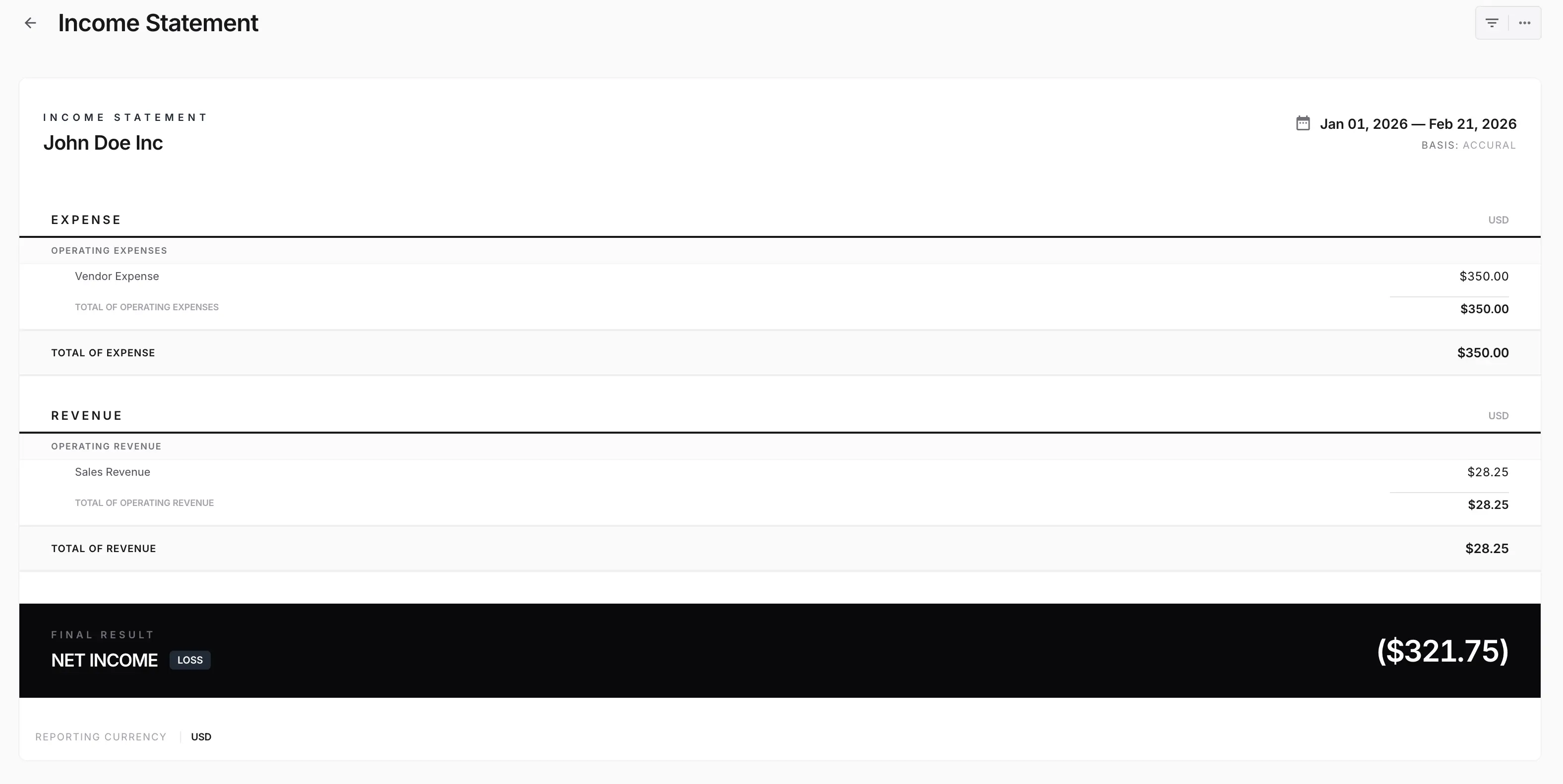
The agent starts from the financial statement generated by the ledger, then drills into the records behind material movements.
Example sequence
User: How did we perform vs last month?

Agent:
  1. confirm company + period
  2. income statement (current + prior)
  3. flag largest revenue/expense variances
  4. expense report for top cost movers
  5. sales report if revenue shifted
  6. GL for exceptional lines
  7. net income summary + follow-ups — stop before posting
7. Finance-Grade Answer Contract
| Required output | What to include |
|---|---|
| Scope | Company, currency, accounting basis if known, and exact periods |
| Headline | Revenue, gross profit where available, operating result, and net income |
| Comparison | Current value, prior value, absolute change, and percentage change |
| Drivers | Material revenue and expense movements with report evidence |
| Exceptions | Uncategorized, unusual, or manually adjusted activity needing review |
| Validation | GL or trial-balance checks performed for material items |
| Evidence | Reports, filters, and drilldowns used |
| Safe stop | No accrual, reclassification, or journal posted automatically |
The agent should separate fact from interpretation. “Software expense increased by 18%” is a report-backed fact; “the team is overspending” is a recommendation that needs business context.
8. Workflow Checklist
| # | Action | MCP tools |
|---|---|---|
| 1 | Confirm period | Company summary |
| 2 | Run P&L | Income statement |
| 3 | Compare prior period | Income statement |
| 4 | Explain cost variances | Expense report |
| 5 | Explain revenue if needed | Sales report |
| 6 | Validate exceptions | GL, trial balance |
Use it or embed it
- Use this workflow in NewLedger: open
Settings > App Connect > MCP Server, grant read scope, and ask "How did we perform this month versus last month?" - Embed it with Paprel: add a tenant-aware performance copilot to your SaaS, fintech, marketplace, or portfolio product while Paprel provides the ledger and reporting layer.
Start with reporting and explanation. Add draft-journal access only after the agent reliably cites periods, evidence, and material exceptions.
9. Follow-Up Questions
- Net income this month? · Revenue vs last month?
- Biggest expense increases? · Gross margin trend?
- Uncategorized spend? · GL behind payroll or rent?
- How does cash movement differ from reported profit?
- If an approved budget source is connected, how does actual performance compare with budget?
10. Best Practices
- Lock the period before comparing.
- Separate revenue growth from margin and cost control.
- Reconcile material P&L lines to GL at month-end.
Income statement -> variance analysis -> expense/sales drilldown -> GL check -> reviewed summary
11. Common Questions
What is an AI financial reporting agent?
It is an agent that retrieves financial statements, compares periods, investigates material variances, and prepares a management narrative with report and ledger evidence. It should explain what changed without presenting unsupported business judgments as accounting facts.
Can an AI agent perform P&L analysis?
Yes. It can compare revenue and expense lines, calculate changes, and drill into sales, expenses, and General Ledger activity. The reporting periods, accounting basis, materiality threshold, and business context still need to be explicit.
How does this support month-end close?
The agent can prepare first-pass variance commentary, flag unusual entries, and assemble evidence for review. It does not replace reconciliations, period controls, accountant judgment, or final approval of the financial statements.
Related Concepts
Profit and loss, income statement, net income, financial reporting, AI agent, AI accounting, agentic API, Paprel MCP, embedded accounting, month-end close, management reporting.
Read Next
- Accounts Receivable AI Agent Playbook
- Accounts Payable AI Agent Playbook
- Paprel MCP for AI Agents
- Double-Entry Ledger Architecture
- Build vs Buy Embedded Accounting
Product guidance from the Paprel team based on current product behavior, integration design, and embedded accounting workflow patterns. Posts are reviewed before publication and updated when implementation details materially change.
Build in sandbox, launch with a production trial
Use sandbox for developer testing with no billing. When you are ready for real workflows, start production on a monthly plan with a 14-day free trial.